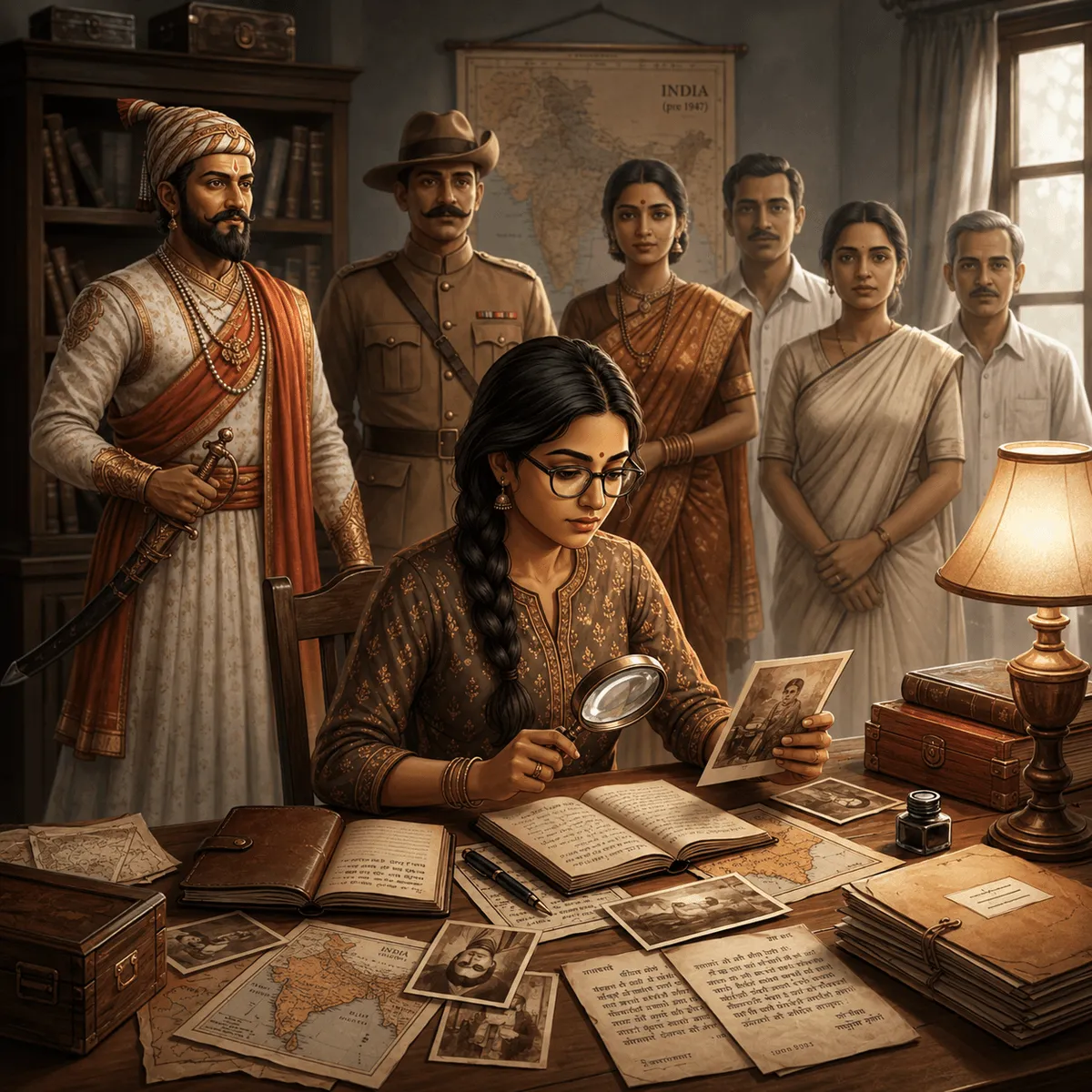
Step 1: Start with What You Know
Every ancestry search begins at home. Before you consult any records, document everything you already know:
- Your parents’ full names, birth dates, and birthplaces.
- Your grandparents’ names and where they grew up.
- Your gotra, kul devta, and ancestral village (mool sthan) if known.
- Any family stories about migration, partition, or notable ancestors.
- Old photos, letters, certificates, and documents.
Enter all this into ParivaarPro’s Family Tree Builder immediately. This becomes your working document that you’ll expand as you discover more.
Step 2: Interview Living Elders — Urgently
Your oldest living relatives are your most valuable source. They carry knowledge that no document can replace. Prioritise interviews with:
- Grandparents (Dada/Dadi, Nana/Nani) — They knew your great-grandparents personally.
- Grand-uncles and grand-aunts (Bade Tau/Tai, Bade Mama/Mami) — Often remember different details than your grandparents.
- Family pandits/purohits — Hereditary priests who may have served your family for generations.
Critical tip: Record these conversations on your phone. Ask open-ended questions: “Tell me about your childhood” yields more than “What was Dada’s father’s name?”
Step 3: Panda Records at Haridwar, Gaya, Nashik
India’s tirth purohits (pandas) at pilgrimage centres have maintained hand-written genealogical registers (bahis) for centuries. These are among the oldest continuously maintained genealogical archives in the world.
- Haridwar — Contact Ganga Sabha for your family’s panda. Provide surname, gotra, and ancestral village.
- Gaya — Pind-daan records contain detailed family trees recorded during ancestral rites.
- Nashik — Kumbh Mela records for Marathi and Gujarati families at Panchvati.
- Varanasi — Shraadh records at Manikarnika Ghat.
Read our detailed guide: Purohit Vanshavali Online Kaise Dekhein.
Step 4: Village Patwari and Land Records
If you know your ancestral village, the patwari (village accountant/land records officer) is a goldmine:
- Khatiyan/Khasra records — Land records from British era onward. They record the owner’s name, father’s name, and caste — creating a chain of succession.
- Jamabandi — Revenue records in Punjab/Haryana that go back to the 1860s.
- Record of Rights (RoR) — Contains ownership history traceable through generations.
Many states have digitised these records. Search for “[state name] bhulekh” or “[state name] land records online”.
Step 5: British-Era Gazetteers and Census
The British Raj conducted detailed district gazetteers and decennial censuses from the 1860s onward. These are invaluable for ancestor research:
- District Gazetteers — Available on archive.org. Search for “[district name] gazetteer”. They describe prominent families, caste structures, and village histories.
- Census of India (1871-1931) — Available at censusindia.gov.in archives. Contain caste-wise population data, sometimes with family-level details.
- Indian Army Records — If ancestors served in the British Indian Army, records exist at the National Archives of India, New Delhi.
- Church records — For Christian families, church registers contain baptism, marriage, and burial records going back centuries.
Step 6: FamilySearch.org — Free Global Database
FamilySearch.org is the world’s largest free genealogy database, maintained by the LDS Church. It has significant Indian collections:
- Microfilmed panda records from Haridwar.
- Church records from Goa, Kerala, and Tamil Nadu.
- British-era civil registration records.
- Cemetery and burial records.
Create a free account and search for your surname, district, and state. You may be surprised at what surfaces.
Step 7: DNA Testing (Optional but Powerful)
DNA testing services like 23andMe, AncestryDNA, and MyHeritage DNA can reveal:
- Ethnic composition — What percentage of your DNA is South Asian, Central Asian, European, etc.
- Migration patterns — Where your ancestors likely came from thousands of years ago.
- DNA matches — Find distant relatives who have also tested. This can break through research dead ends.
- Haplogroups — Your deep ancestral lineage on the Y-chromosome (paternal) or mitochondrial (maternal) line.
DNA testing is most useful as a complement to traditional research, not a replacement. It confirms or challenges paper-trail findings.
Step 8: National Archives and State Archives
The National Archives of India (New Delhi) and state archives hold:
- Freedom fighter records (many families have unrecognised freedom fighters).
- Princely state records — births, deaths, and marriages registered in former princely states.
- Revenue records — detailed land ownership and transfer documents.
- Personal papers — donated by prominent families.
Step 9: Organise Everything in a Digital Family Tree
As you discover information from multiple sources, enter everything into ParivaarPro:
- Create profiles for every ancestor you discover, even with incomplete information.
- Upload photos of old documents, bahi pages, and land records as notes.
- Record gotra, kul devta, mool sthan, and any stories in the notes field.
- Share the tree with relatives — they may have missing pieces.
Your digital family tree becomes a living, collaborative document that grows richer with every conversation and every discovery.
Ancestry Research FAQ (अक्सर पूछे जाने वाले सवाल)
- Apne purvaj ke baare mein kaise jaanein?
- Start by interviewing living elders, then move to panda records, village patwari/land records, British-era gazetteers and census, FamilySearch.org, and optionally DNA testing — recording everything in a digital family tree as you go.
- Kitni generation peeche tak ja sakte hain?
- Typically four to eight generations through panda and land records. DNA testing can reveal migration patterns going back thousands of years, though not specific names.
- Kya ancestry research free hai?
- FamilySearch, archive.org gazetteers and ParivaarPro are free. DNA testing costs roughly ₹5,000–₹15,000, and panda record access is usually free or needs a small dakshina.
- Partition ke baad ke purvajon ke records kaise milenge?
- Haridwar panda bahis often hold pre-Partition details, and British-era district gazetteers on archive.org cover regions now in Pakistan and Bangladesh.
- Online land records se ancestors kaise trace karein?
- Search “[state] bhulekh” for digitised khatiyan/khasra and jamabandi records. The owner-and-father-name chains in these revenue records let you reconstruct succession over generations.