Gotra Ka Matlab (गोत्र का मतलब क्या है)
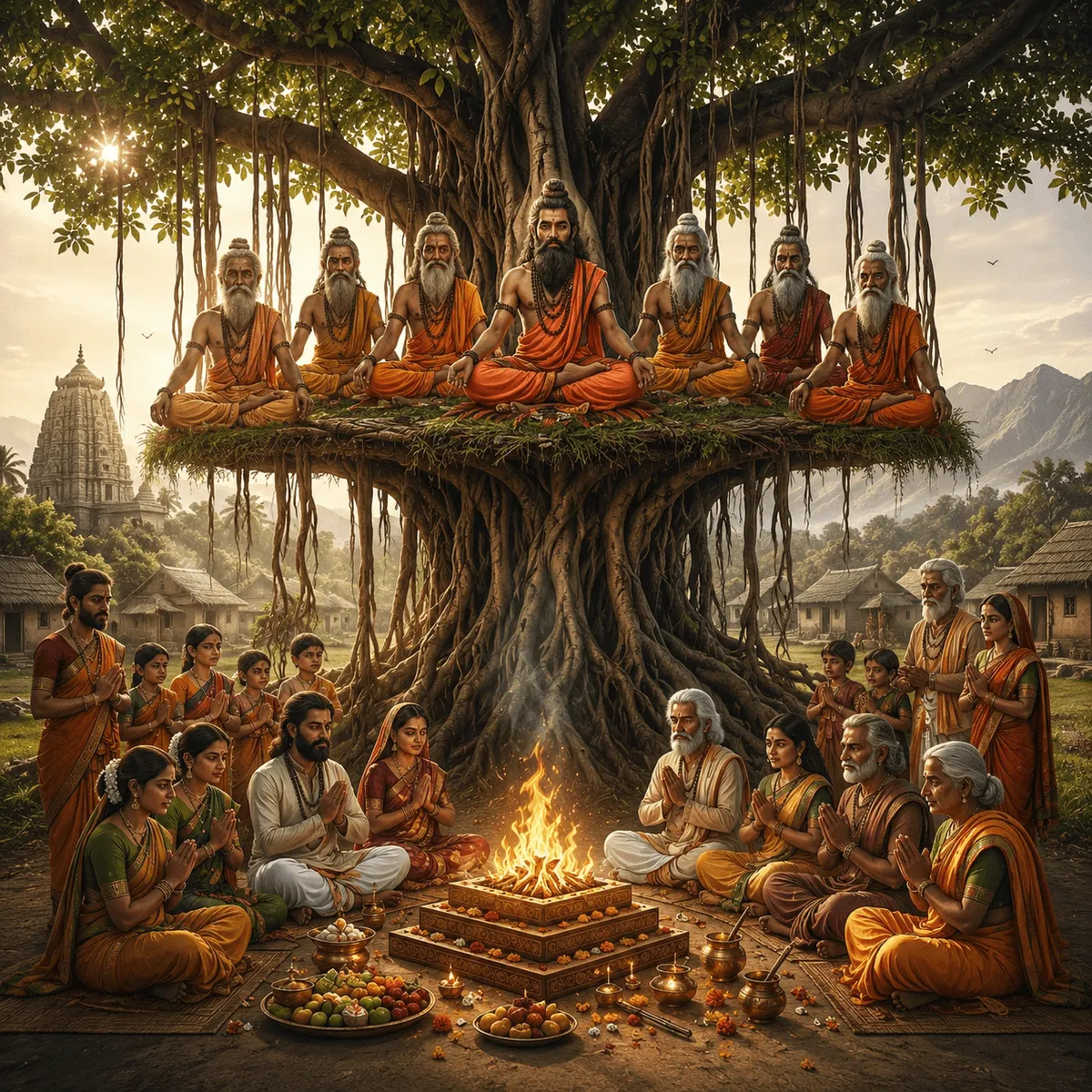
The word gotra is built from two Sanskrit roots: “go” (cow) and “tra” (shelter or protection) — literally a “cow-pen”. In the Vedic age, cattle were the centre of a family’s wealth, and the households that shared one cowshed were understood to belong to a single descent group. Over the centuries the meaning shifted from a physical enclosure to an abstract one: a patrilineal clan descended from a common ancestral rishi (sage).
So when someone asks “gotra kya hota hai”, the shortest accurate answer is this: your gotra is the spiritual surname of your father’s line, pointing all the way back to one of a small number of founding sages. Every Hindu inherits a gotra at birth, it never changes for a man, and it is the single most important piece of identity used in Vedic rituals, the sankalpa(statement of intent before a puja), and traditional matchmaking.
Unlike a modern surname, which can be adopted, dropped, or changed by deed, the gotra is treated as fixed by birth. This permanence is exactly why it became the tool Hindu society used to regulate marriage and to remember ancestry long before written records existed.
The 8 Root Gotras: Saptarishi + Agastya
Classical texts trace all gotras back to 8 root gotras — the seven Saptarishis plus the sage Agastya. Every one of the hundreds of gotras in use today is a branch of these eight:
As these sages’ descendants multiplied, prominent figures in later generations founded their own named sub-lineages — Bharadwaj, Sandilya, Parashar, Kaushik and many more. This is how a handful of root gotras expanded into the large gotra lists each community uses today. When you trace any modern gotra far enough back, it resolves to one of these eight original rishis.
Gotra vs Pravara: The Difference People Miss
One of the most common points of confusion is the difference between gotra and pravara (प्रवर). They are related but not the same thing:
- Gotra names the single founding sage of your lineage.
- Pravara is the list of illustrious rishi ancestors — usually one, three, or five sages — recited during the sankalpa before rituals, weddings and shraddha.
This matters for marriage. Tradition prohibits marriage not only between two people of the same gotra, but also between two people whose pravaras share even one common rishi. So a couple from two different-sounding gotras may still be barred if their pravara lists overlap. When a family pandit checks compatibility, the pravara is what they actually read out — which is why knowing only your gotra is sometimes not enough.
How Gotra Is Inherited: The Patrilineal Rule
Gotra passes strictly through the male line — father to child. A child takes the father’s gotra at birth. A woman carries her father’s gotra until marriage, and then, in the traditional system, adopts her husband’s gotra. This single rule is the mechanism behind the entire same-gotra marriage prohibition: if a man and woman share a gotra, they are treated as descendants of the same male ancestor and therefore as siblings in lineage terms.
- Adopted children traditionally take the gotra of their adoptive father.
- Unknown gotra defaults to Kashyap gotra, since Kashyapa is held to be an ancestor of all.
- Reformist communities increasingly let women retain their birth gotra, but the inherited-from-father convention remains dominant.
Gotra vs Surname vs Kul: Clearing the Confusion
People often use gotra, surname and kul interchangeably. They are three different layers of identity:
The practical takeaway: two people can share the surname “Sharma” yet belong to entirely different gotras, and two people with different surnames can share one gotra. For marriage and ritual, it is the gotra and pravara that count — not the surname. If you want to keep all of these straight across generations, recording each one in a structured family tree is far more reliable than memory.
Apna Gotra Kaise Pata Kare (How to Find Your Gotra)
If you don’t know your gotra, here is the order most families follow to find it:
- Ask the eldest in your father’s line — your dada/dadi or a great-uncle. Gotra travels with the paternal side, so paternal elders are the first source.
- Consult your family purohit — the pandit who performs your family’s weddings and shraddha usually records both gotra and pravara.
- Check panda bahi records — the tirth purohits at Haridwar, Gaya and Nashik maintain centuries-old registers organised by family and village, with gotra noted against each entry.
- Look at your janam kundali — a properly prepared birth chart often records the native’s gotra in the header.
- Community / caste associations and old patwari land records in the ancestral village frequently mention gotra too.
Once you confirm it, write it down somewhere permanent. Gotra is exactly the kind of detail that disappears in a single generation when an elder passes away without it being recorded.
Sagotra Vivah: Same-Gotra Marriage Rules and Law
Traditional Hindu dharma prohibits sagotra vivah — marriage between two people of the same gotra — on the principle that they descend from the same rishi and are therefore lineage siblings. The same logic extends to shared pravaras and, in many communities, to the mother’s gotra as well.
The legal position is more nuanced. The Hindu Marriage Act, 1955 does notban same-gotra marriage outright. What it prohibits is marriage between sapindarelatives — Section 3(f) bars unions within 5 generations on the father’s side and 3 on the mother’s side — and between those in “degrees of prohibited relationship.” Sagotra and sapinda overlap but are not identical concepts.
Crucially, the Act respects custom: where a community has a well-established practiceof permitting sagotra marriage, the law treats such marriages as valid, and courts have repeatedly upheld them. So a same-gotra marriage may be socially discouraged in one community and perfectly normal in another. If you need to verify how closely two people are actually related, a multi-generation family tree makes the sapinda check objective rather than a matter of memory.
Gotra List by Community
Below is a representative gotra list across major communities. These are illustrative, not exhaustive — most communities recognise dozens of gotras:
- Brahmin gotra list: Bharadwaj, Kashyap, Vatsa, Gautam, Sandilya, Parashar, Garg, Kaushik, Atri, Bhrigu, Vasishtha, Agnihotri, Bhargava, Shaunak
- Rajput: Suryavanshi (Gahlot, Sisodia), Chandravanshi (Jadaun, Bhati), Agnivanshi (Chauhan, Solanki, Parmar, Pratihara)
- Jat: Dahiya, Malik, Tomar, Dhankar, Hooda, Ahlawat, Sangwan, Kadian
- Maratha: Bhonsle, Shirke, Jadhav, Shinde, Holkar, Gaikwad, More
- Agarwal / Vaishya: Garg, Bansal, Mittal, Kansal, Goyal, Singhal, Mangal, Jindal, Tayal, Bindal (the classic “saadhe satra” / 18 gotras)
- Kayastha: Saxena, Srivastava, Mathur, Nigam, Bhatnagar, Kulshreshtha (the 12 Chitraguptavanshi sub-clans)
Your exact gotra depends on your specific family line within the community, not just the caste or surname — which is why confirming it with elders or a purohit beats guessing from a list.
Gotra and Modern Genetics
The gotra system is a striking pre-scientific parallel to Y-chromosome inheritance: both pass unchanged from father to son down the generations. A few genetic studies have explored whether men of the same gotra carry shared Y-DNA markers. The findings are mixed — thousands of years of population mixing and genetic drift mean two same-gotra people today are usually not close biological relatives.
That said, the prohibition on same-gotra and sapinda marriage does have a sound effect: it discourages consanguineous (close-relative) marriage, which medical genetics confirms reduces the risk of recessive genetic disorders in offspring. So the ancient rule, whatever its spiritual rationale, aligns reasonably well with what modern science recommends about genetic diversity.
Common Myths About Gotra
- “Same surname means same gotra.” False — surname and gotra are independent layers.
- “Gotra and caste are the same thing.” No — a single caste contains many gotras, and the same gotra name can appear across communities.
- “Same-gotra marriage is illegal in India.” Not true — the law bars sapinda relationships, and upholds sagotra marriage where custom permits it.
- “Women have no gotra.” Women do have a gotra (the father’s), which traditionally changes to the husband’s at marriage.
Recording Your Gotra in a Digital Family Tree
Gotra, pravara and kul devta are precisely the details that vanish when they live only in an elder’s memory. ParivaarPro gives every family member a dedicated gotra field, so the information is stored alongside names, relationships and photos. When you build your family tree or a traditional vanshavali, the gotra is preserved for your children and grandchildren — and it makes future marriage and ritual checks instant instead of a round of phone calls to relatives.
Gotra FAQ (अक्सर पूछे जाने वाले सवाल)
- Gotra kya hota hai in simple words?
- Gotra (गोत्र) is your patrilineal clan identity. It traces every Hindu family back to one of the ancient Vedic sages — the Saptarishis. You inherit your gotra from your father, and it stays the same for life, much like a very old surname rooted in spiritual lineage.
- Apna gotra kaise pata kare (how do I find my gotra)?
- Ask your father, grandfather, or family purohit first — elders almost always know. You can also check Haridwar, Gaya or Nashik panda bahi records, your janam kundali, community gotra registers, or old village patwari land records.
- Can same-gotra (sagotra) people marry?
- Traditional Hindu custom prohibits sagotra vivah because the couple is considered to share a common rishi ancestor. Legally, the Hindu Marriage Act 1955 does not ban it directly — it bars sapinda relationships instead. Where a community has an established custom permitting sagotra marriage, courts have upheld it as valid.
- Is gotra the same as surname (jaati or upnaam)?
- No. Gotra is your spiritual lineage from a rishi, while a surname usually reflects occupation, region, or caste. Two people with the same surname can have different gotras, and people with different surnames can share one gotra.
- What is pravara and how is it different from gotra?
- Pravara is the list of illustrious rishi ancestors a family recites during sankalpa and rituals. Gotra names a single founding sage; pravara names the chain of one, three, or five sages linked to that gotra. Two gotras sharing a pravara are also treated as non-marriageable.
- What gotra do I get if my gotra is unknown?
- Families who cannot trace a gotra traditionally use Kashyap gotra, since Kashyapa is considered a progenitor of all beings. Many purohits apply this default during weddings and pujas when records are lost.
- Does a woman keep her gotra after marriage?
- In the traditional patrilineal system a woman adopts her husband’s gotra after marriage. Some reformist communities now let women retain their birth gotra, but the inherited-from-father, changed-at-marriage convention is still the most common across India.