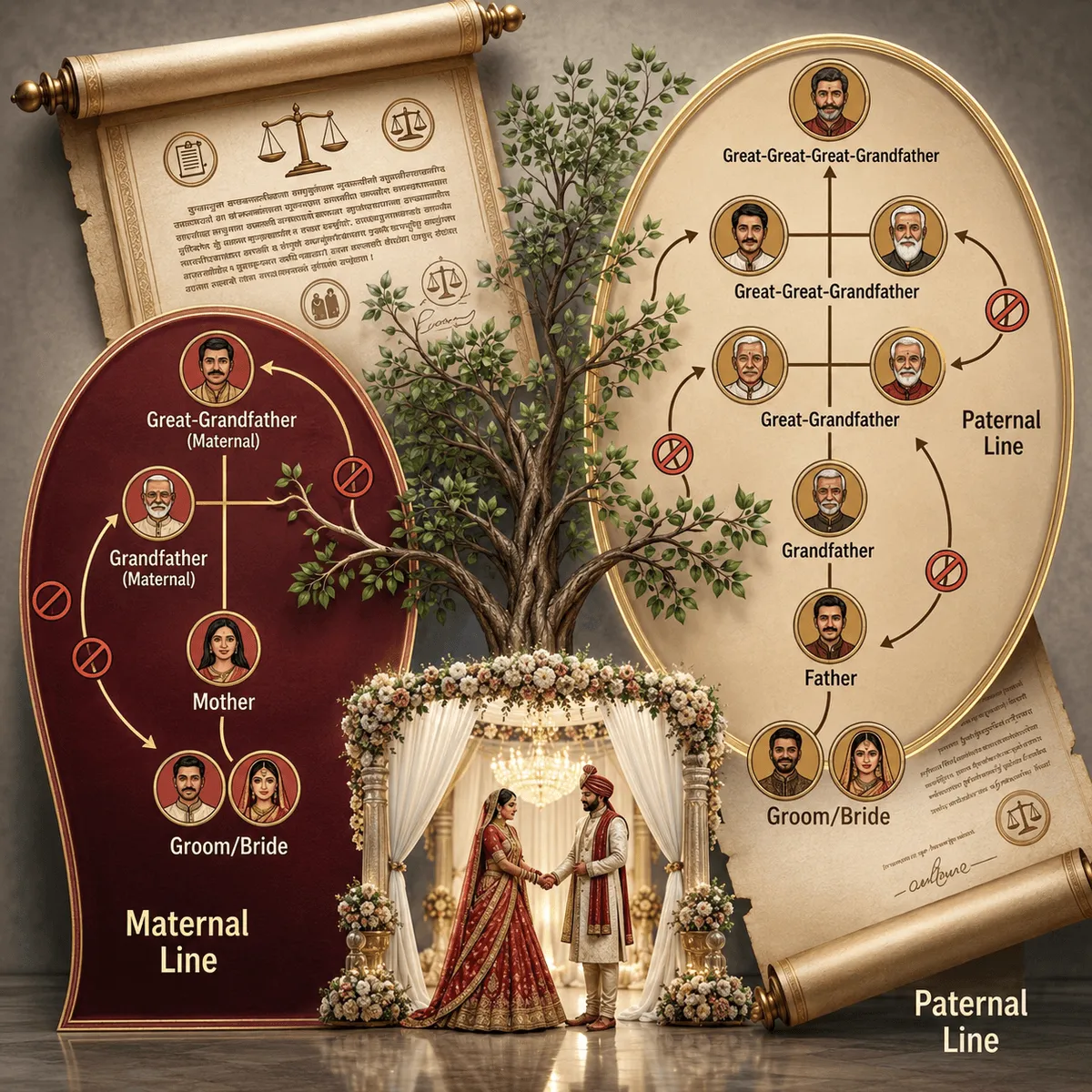
Sapinda Ka Matlab (सपिंड का मतलब)
The word sapinda (सपिंड) comes from Sanskrit: sa (same) + pinda (body/ancestor offering). In Vedic tradition, pinda-daan is the offering of rice balls to deceased ancestors during shraadh. People who share the obligation to offer pinda to the same ancestors are called sapinda — they share a common ancestral body.
In legal terms (Section 3(f) of the Hindu Marriage Act), two people are sapinda if:
- They share a common ancestor within 5 generations on the father’s side (including the person themselves).
- They share a common ancestor within 3 generations on the mother’s side (including the person themselves).
How to Count Generations: The 5-3 Rule
The Act counts the person themselves as Generation 1:
- Father’s side (5 generations): Self → Father → Grandfather (Dada) → Great-grandfather (Par-dada) → Great-great-grandfather → 5th ancestor
- Mother’s side (3 generations): Self → Mother → Grandmother (Nani) → 3rd ancestor
Example: If Rahul and Priya share the same great-great-grandfather on the father’s side, that is 4 generations apart from each. Since the Act prohibits within 5, this marriage would be a sapinda marriage and therefore prohibited.
Example 2: If Arjun and Sneha share the same maternal grandmother (Nani), that is 2 generations on the mother’s side. Since the Act prohibits within 3, this is also prohibited.
Sapinda vs Sagotra: They Are NOT the Same
Two people can be sagotra but not sapinda — they share the same ancient rishi lineage but have no common ancestor within 5/3 generations. Such a marriage is not prohibited by law even if some communities frown upon it culturally. For the full picture of gotra and sagotra rules, see Gotra kya hota hai.
Conversely, two people can be sapinda but different gotra — e.g., maternal cousins have different gotras (from their respective fathers) but share a common maternal ancestor within 3 generations.
Hindu Marriage Act 1955: Section 5(v) and 3(f)
Section 5 of the Hindu Marriage Act lists conditions for a valid Hindu marriage. Clause (v) states that the parties must not be sapindas of each other, unless a custom or usage governing one of them permits such a marriage.
Section 3(f) defines sapinda relationship as:
- Two persons are sapinda of each other if one is a lineal ascendant of the other within the limits of sapinda relationship.
- Or if they have a common lineal ascendant who is within the limits of sapinda relationship with respect to each of them.
- Limits: 5 ascending generations through the father, 3 through the mother.
The Custom Exception: When Sapinda Marriage Is Legal
The Act includes a crucial exception: if there is a long-standing custom or usage governing either party that permits sapinda marriage, the marriage is valid.
- South Indian cross-cousin marriages — Many South Indian communities traditionally marry maternal uncle’s daughter (mama’s daughter). This is sapinda by law but legal through custom.
- Some tribal communities — Certain Adivasi communities permit marriage within sapinda degrees by established custom.
- Court rulings — Indian courts have upheld sapinda marriages when the parties could prove an established community custom allowing it.
Legal Consequences of Prohibited Sapinda Marriage
- A marriage performed in violation of Section 5(v) is voidable — it can be annulled by a court if either party petitions.
- It is not automatically void — it remains valid unless challenged.
- Children born from such a marriage are legitimate regardless of whether the marriage is later annulled.
- No criminal penalty — sapinda marriage is a civil matter, not criminal.
How a Family Tree Helps Verify Sapinda Relationship
The simplest way to check whether a proposed marriage violates sapinda rules is to map both families’ trees and look for shared ancestors within 5 (paternal) or 3 (maternal) generations.
ParivaarPro’s Family Tree Builder lets you:
- Build both the boy’s and girl’s family trees.
- Count generations upward from each person.
- Check if any ancestor appears in both trees within the sapinda limit.
This is especially useful in small communities where families intermarry frequently and relationships are complex.
Sapinda Rules and Modern Genetics
From a genetic perspective, the sapinda rules make biological sense. Marriage between close relatives (consanguinity) increases the risk of autosomal recessive genetic disorders. The 5-3 generation rule roughly corresponds to a genetic relatedness threshold below which consanguinity risks become negligible.
Modern genetic counselling recommends avoiding marriage between people who share more than ~6% of their DNA — which roughly aligns with the 5-generation paternal and 3-generation maternal limits.
Sapindi Vivah FAQ (अक्सर पूछे जाने वाले सवाल)
- Sapindi vivah kya hota hai simple mein?
- A sapindi marriage is one between a couple who share a common ancestor within 5 generations on the father’s side or 3 on the mother’s side. Under the Hindu Marriage Act 1955 such a marriage is prohibited unless a valid custom permits it.
- Kya same gotra (sagotra) marriage illegal hai?
- No. The law does not directly ban sagotra marriage — it only prohibits sapinda relationships. Sagotra and sapinda are different concepts, and many sagotra couples are not sapinda at all.
- South India mein mama ki beti se shaadi kaise legal hai?
- Through the custom exception in Section 5(v). Several South Indian communities have a long-standing tradition of cross-cousin marriage, and where that custom can be established, the law treats the marriage as valid even though it is sapinda.
- Sapinda marriage ki legal consequence kya hai?
- A prohibited sapinda marriage is voidable — it can be annulled if a party petitions — but it is not automatically void, and children of the marriage remain legitimate. It is a civil matter with no criminal penalty.
- Family tree se sapinda relationship kaise check karein?
- Build both families’ trees and look for any shared ancestor within 5 generations on the paternal side or 3 on the maternal side. If a common ancestor appears within those limits, the couple is sapinda.