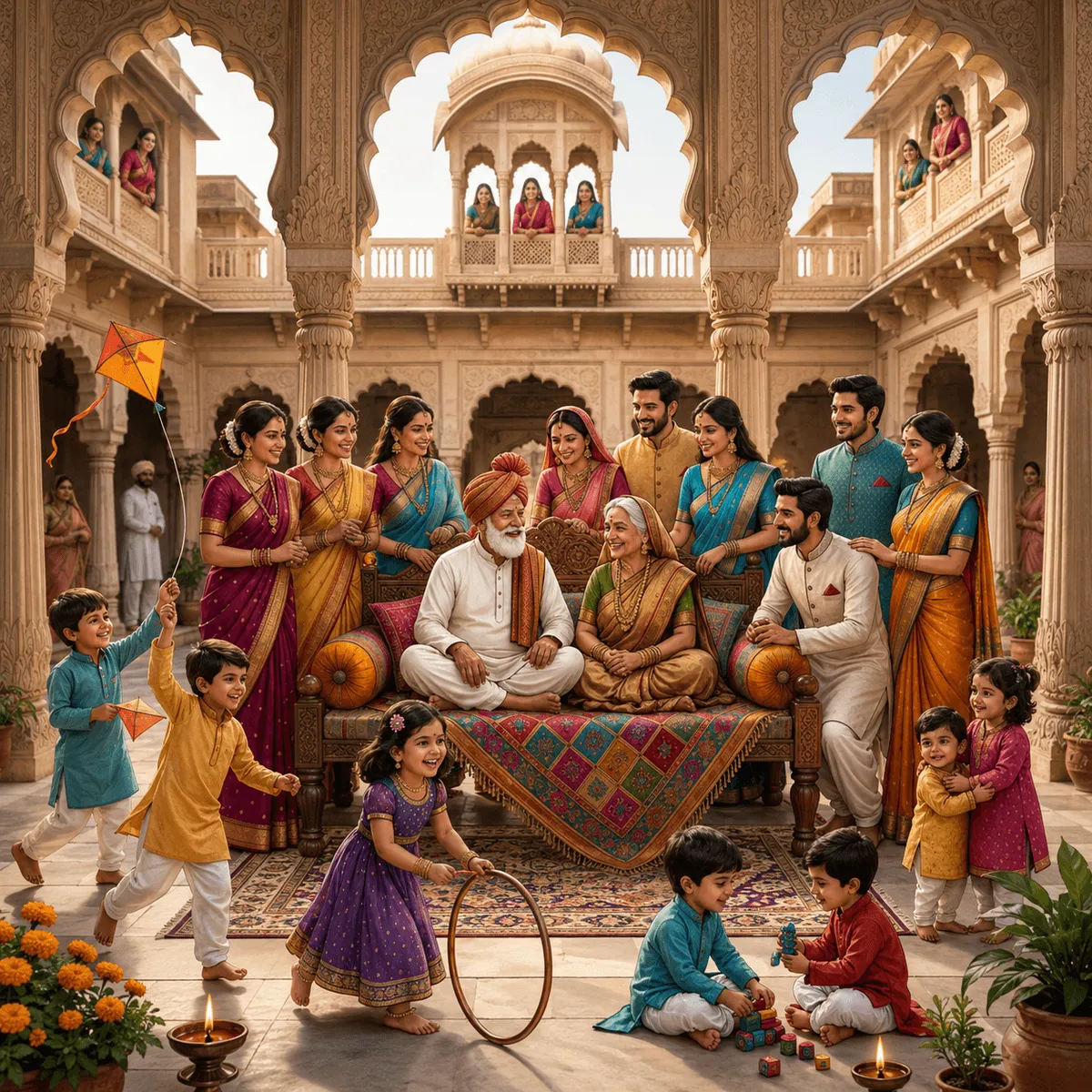
Khandaan Ka Matlab (Literal and Cultural)
The word khandaan (खानदान) comes from Persian “khaan-daan” — literally “the house of the khan (chief)”. In Indian usage, it means the entire extended patrilineal family network spanning multiple generations. When someone says “hamare khandaan mein aisa nahi hota” (this doesn’t happen in our khandaan), they are invoking generations of shared values and reputation.
Unlike the English “family”, which usually refers to the nuclear unit (parents + children), khandaan encompasses grandparents, uncles, cousins, and even distant relatives who share the same patrilineal surname.
Khandaan vs Parivaar vs Vansh vs Gotra
In practice: you belong to a gotra (sage lineage), a vansh (dynasty), a khandaan (extended family), and a parivaar (immediate family). These are concentric circles of identity.
Khandaan and the Joint Family System
The traditional Indian sanyukt parivaar (joint family) was the living embodiment of the khandaan. Multiple generations lived under one roof, shared a common kitchen (chulha), and pooled resources under a family elder (the Karta).
Key features of this system:
- Shared property — Ancestral property (HUF property) belonged to the khandaan, not individuals.
- Collective decision-making — Marriages, education, and major purchases were decided by the family council.
- Built-in social security — Elders were cared for, widows were supported, orphans were raised by uncles.
- Conflict too — Property disputes between brothers, tension between Jethani and Devrani, and generational clashes were common.
Khandaan Ki Izzat: Family Reputation
In Indian culture, “khandaan ki izzat” (family honour) is a powerful social force. Every member’s behaviour reflects on the entire khandaan. This is why:
- Marriage proposals evaluate the boy/girl’s khandaan, not just the individual.
- Professional achievements are described as “khandaan ka naam roshan karna” (bringing glory to the family name).
- Scandals affect the entire family network, not just the person involved.
While this system has both positive and negative aspects, understanding khandaan dynamics is essential for understanding Indian social behaviour.
How Khandaan Is Changing in Modern India
Urbanisation, nuclear families, and globalisation are transforming the khandaan concept:
- Geographic dispersion — Khandaan members are now spread across cities and countries.
- Nuclear shift — Young couples prefer independent living, weakening joint family bonds.
- WhatsApp groups — The modern khandaan reunion happens in family WhatsApp groups.
- Property division — Joint HUF property is increasingly partitioned, fragmenting economic ties.
- Inter-caste/inter-faith marriages — Traditional khandaan boundaries are becoming more fluid.
But the emotional core remains. Festivals, weddings, and crises still bring the khandaan together. The challenge is keeping the connection alive in a digital world.
Khandaan and HUF (Hindu Undivided Family) for Tax
The Hindu Undivided Family (HUF) is a legal entity recognised by Indian tax law. It allows a khandaan to hold joint property and file taxes as a separate unit, with significant tax benefits. Key points:
- An HUF has a Karta (head, usually eldest male) and coparceners (family members with property rights).
- After the 2005 amendment, daughters are equal coparceners.
- An HUF gets its own PAN card and tax-free income slab (₹2.5 lakh basic exemption).
- A clear family tree/vanshavali is essential for establishing HUF membership.
How to Document Your Khandaan Digitally
Use ParivaarPro to build a visual map of your khandaan:
- Start with the oldest known patriarch (or matriarch) as the root.
- Add each generation downward: their children, spouses, and grandchildren.
- Record gotra, kul devta, mool sthan in the profile fields.
- Upload photos and add notes about each person’s life.
- Share the tree link with relatives so they can add their branches.
The result is a living, interactive map of your entire khandaan — accessible from any device, backed up in the cloud, and growable by any family member.
Khandaan FAQ (अक्सर पूछे जाने वाले सवाल)
- Khandaan aur parivaar mein kya fark hai?
- Parivaar is your immediate family — parents, siblings, spouse and children. Khandaan is the entire extended patrilineal network spanning many generations, along with the reputation and social identity attached to the family name.
- Khandaan ka matlab kya hai in simple words?
- Khandaan means your extended family lineage — all the people who share your patrilineal surname across generations, together with the honour and standing built up by that line over time.
- Khandaan ka Urdu mein kya matlab hai?
- The meaning is identical — extended family or lineage. The word itself comes from Persian (khaan + daan) and is used the same way in both Urdu and Hindi.
- Is khandaan the same as vansh?
- Not exactly. Vansh is the line of descent or dynasty (for example Suryavansh). Khandaan is broader — it includes living relatives, family reputation and social identity, not just the line of descent.
- How can I document my khandaan?
- Use a free family tree builder like ParivaarPro. Start from the oldest known ancestor, add each generation downward, and record gotra, kul devta and mool sthan against every member so the khandaan is preserved digitally.