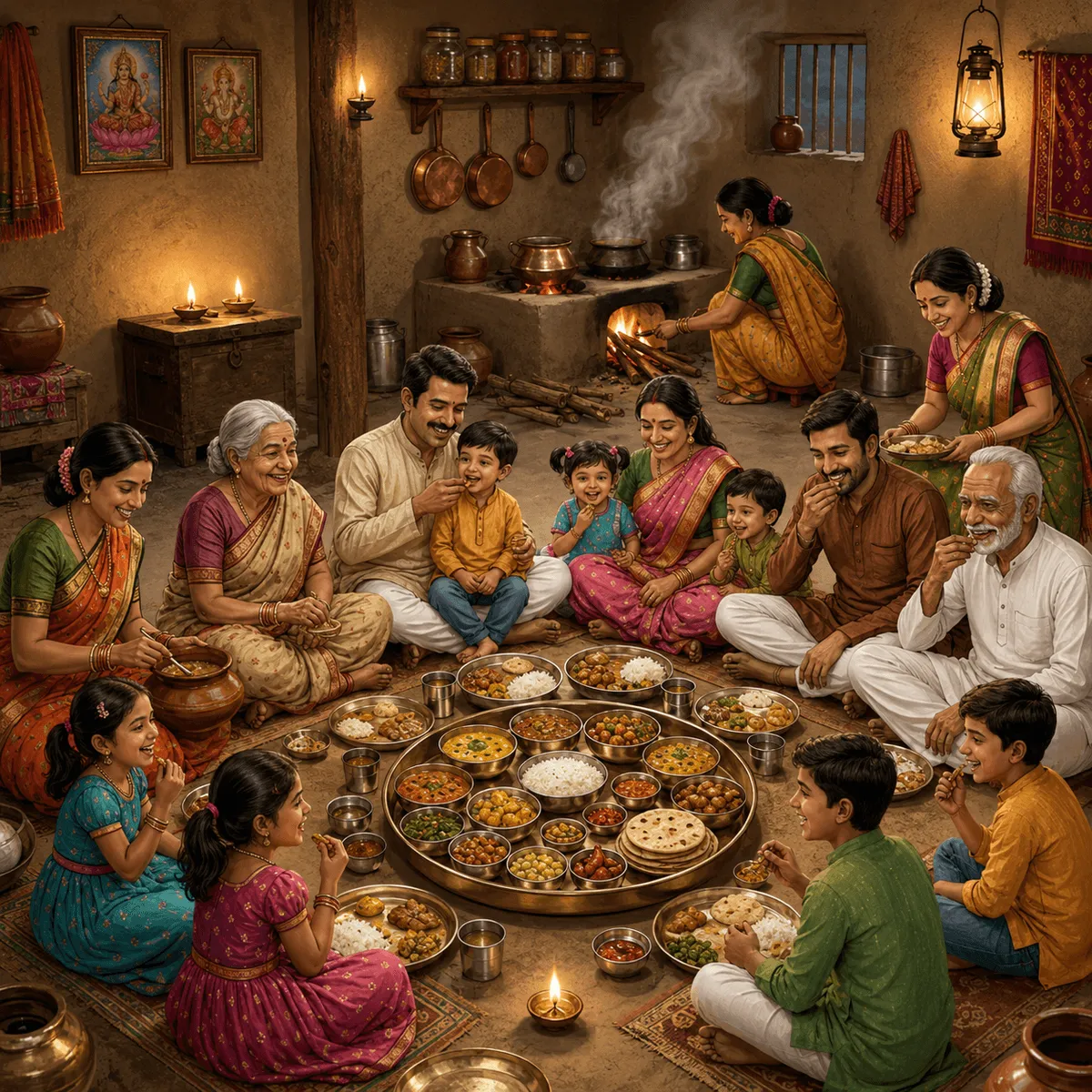
What Is a Sanyukt Parivar (Joint Family)?
A sanyukt parivar (संयुक्त परिवार) is a family structure where three or more generations live together under one roof (or compound), share a common kitchen, pool financial resources, and operate under the authority of a family head (Karta). Typical members include grandparents, their sons and wives, grandchildren, and sometimes great-grandchildren.
The Census of India defines a joint family as one where “two or more married couples living together with or without unmarried children.” By this definition, roughly 20% of Indian households are still joint families (2021 census data), though the number is declining rapidly. The term sits alongside khandaan and parivar as one of the core units of Indian family identity.
Structure of the Joint Family
- Karta (कर्ता) — The head of the family, traditionally the eldest male. He manages property, finances, and major decisions.
- Coparceners — Male members (and now daughters, after the 2005 amendment) who have equal rights to ancestral property.
- Common kitchen (Chulha) — All family members eat from the same kitchen. This is the defining feature of a joint family.
- Shared expenses — Income is pooled. Individual earnings go into a common fund managed by the Karta.
- Internal hierarchy — Tai/Jethani > Chachi/Devrani, based on the age-seniority of their husbands.
Advantages of Joint Family
Challenges of Joint Family
- Lack of privacy — Personal space is limited. Couples rarely have independent living quarters.
- Property disputes — When the Karta passes away, division of ancestral property becomes contentious.
- Unequal burden on women — Daughters-in-law (bahus) often bear the heaviest household workload.
- Suppressed individuality — Career choices, lifestyle preferences, and even food habits are subordinated to the group.
- Conflict between bahus — The Jethani-Devrani dynamic can create friction when resources or authority are unequally distributed.
- Decision bottlenecks — Everything needs the Karta’s approval, which can slow personal progress.
Nuclear Family (Ekal Parivar) — The Alternative
An ekal parivar (एकल परिवार / nuclear family) consists of just parents and their children — typically 3-5 people. Advantages:
- Full privacy and independence.
- Faster decision-making.
- Freedom to choose career, city, and lifestyle.
- Equal partnership between spouses (no in-law hierarchy).
Disadvantages include loneliness, expensive childcare, no safety net for emergencies, and the challenge of caring for ageing parents from a distance.
Joint vs Nuclear: Side-by-Side Comparison
HUF Tax Benefits for Joint Families
Indian tax law recognises the Hindu Undivided Family (HUF) as a separate taxable entity. A joint family can create an HUF and enjoy:
- A separate PAN card and bank account.
- Basic tax exemption of ₹2.5 lakh (separate from individual slabs).
- Deductions under Section 80C, 80D, etc.
- Income from ancestral property taxed at HUF level, not individual level.
A clear family tree/vanshavali is essential for establishing HUF membership and proving coparcenary status.
The Modern Joint Family: Hybrid Models
Many Indian families are adopting hybrid models:
- Same building, separate floors — Each nuclear unit has its own kitchen and space, but the family lives in one compound.
- Weekend joint family — Nuclear families during the week, joint family gatherings on weekends and festivals.
- Digital joint family — Connected through family WhatsApp groups, shared photo albums, and tools like ParivaarPro.
Mapping Large Joint Families Digitally
Joint families can have 30+ members across 4 generations. Keeping track of everyone is challenging. ParivaarPro lets you:
- Map the entire family from the eldest patriarch/matriarch downward.
- Auto-label every relationship (Tau, Chacha, Jethani, Devrani, etc.).
- Add photos, notes, gotra, and contact details for each member.
- Share the tree with all family members via a single link.
- Let different members add their own branches — truly collaborative.
Sanyukt Parivar FAQ (अक्सर पूछे जाने वाले सवाल)
- Sanyukt parivar aur ekal parivar mein kya fark hai?
- A sanyukt (joint) parivar has multiple generations living together with a shared kitchen and pooled income under a Karta. An ekal (nuclear) parivar is just parents and their children in an independent household.
- India mein kitne percent families joint hain?
- Roughly 20% of Indian households are joint families according to recent census data, down from about 35% in the 1990s as urban migration and nuclear living have grown.
- Joint family mein Karta kaun hota hai?
- The Karta is the head of the joint family — traditionally the eldest male, and after the 2005 amendment a daughter can also be Karta. The Karta manages property, finances and major family decisions.
- HUF kaise banate hain aur kya benefit hai?
- Obtain a separate PAN card for the HUF, open a bank account, and declare the Karta. The HUF gets its own basic tax exemption and deductions, and a clear family tree helps establish coparcenary membership.
- Kya joint family system khatam ho raha hai?
- Pure joint families are declining, but hybrid models — same compound with separate kitchens, or weekend joint families connected digitally — are growing as a middle path.