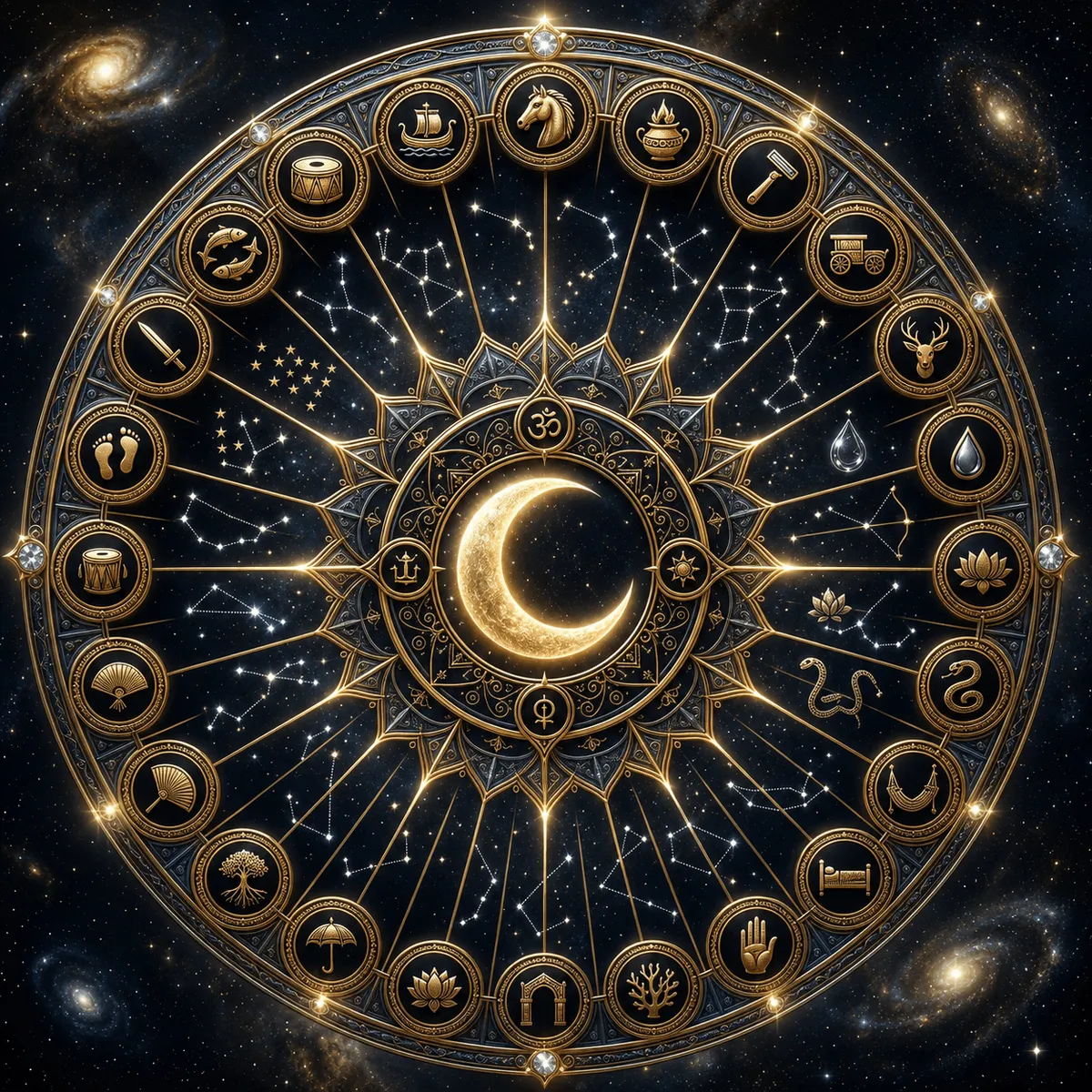
What is a Nakshatra? (नक्षत्र का अर्थ)
The word Nakshatra is derived from two Sanskrit terms: Naksha (meaning map or sky) and Tara (meaning star), or Na (not) and Kshatra (to decay/destroy). Thus, a Nakshatra literally translates to "the star map that never decays."
Vedic astronomy divides the 360-degree path of the ecliptic into 12 equal Zodiac Signs (30 degrees each) and further refines it into 27 equal subdivisions called Nakshatras (each spanning exactly 13 degrees and 20 minutes). These lunar mansions represent the stars or star clusters sitting along the path of the Moon as it orbits the Earth.
Why is Nakshatra More Important Than Zodiac Sign?
In classical Indian astrology (Jyotish), your Moon's nakshatra at the moment of your birth is called your Janma Nakshatra. Sages considered this point far more personal than your Sun sign or even Moon sign because:
- Higher Resolution: Dividing the sky into 27 parts instead of 12 zodiac signs provides more than double the level of psychological and karmic detail.
- Dasha System foundation: Your entire 120-year Vimshottari Mahadasha timeline is calculated based on the exact degree of your Janma Nakshatra at birth.
- The Sound of Your Name: Traditional Indian names are chosen using the specific "naming syllable" (Nama Akshara) linked to your nakshatra's active quarter (pada).
The 27 Nakshatras & Their Ruling Planets
The 27 nakshatras are divided into three groups of nine, each group ruled by the nine planets of Vedic astrology in a repeating sequence:
Deity: Ashwini Kumaras | Symbol: Horse Head
Represents swift speed, physical healing, initiative, and the spark of new beginnings.Deity: Yama (God of Justice) | Symbol: Yoni / Cradle
Represents heavy struggles, deep transformation, and immense inner strength.Deity: Agni (God of Fire) | Symbol: Razor / Flame
Represents fiery purification, sharp intellect, and critical leadership.Deity: Brahma (Creator) | Symbol: Chariot / Temple
The favorite of the Moon, representing physical beauty, fertility, growth, and artistic luxury.Deity: Soma (Moon God) | Symbol: Deer Head
Represents seeking, intellectual curiosity, gentle exploration, and travel.Deity: Rudra (God of Storms) | Symbol: Tear Drop
Represents intense storms, deep emotional cleansing, and intellectual breakthroughs.Deity: Aditi (Mother of Gods) | Symbol: Quiver of Arrows
Represents the return of light, recovery of lost objects, and absolute optimism.Deity: Brihaspati (Guru) | Symbol: Cow Udder / Flower
The most auspicious nakshatra, governing spiritual nourishment, security, and caregiving.Deity: Nagas (Serpents) | Symbol: Coiled Snake
Governs intense mental concentration, secret wisdom, and protection of boundaries.Deity: Pitris (Ancestors) | Symbol: Royal Throne
Represents royal status, lineage pride, inheritance, and ancestral legacy.Deity: Bhaga (God of Fortune) | Symbol: Hammock / Bed legs
Governs worldly comfort, romantic love, fine arts, and relaxing luxury.Deity: Aryaman (God of Patronage) | Symbol: Four Poster Bed
Represents social responsibility, lasting relationships, and helpful networks.Deity: Savitr (Sun God) | Symbol: Clenched Fist / Hand
Represents craftsmanship, clever strategy, manual dexterity, and trade.Deity: Vishwakarma (Architect) | Symbol: Shining Gemstone
Represents structural architecture, sparkling design, and magnetic visual beauty.Deity: Vayu (Wind God) | Symbol: Sprout in Wind
Governs independence, free enterprise, business adaptability, and movement.Deity: Indra & Agni | Symbol: Triumphal Arch
Governs deep focus, goal-oriented drive, and late but immense success.Deity: Mitra (God of Friendship) | Symbol: Lotus Flower
Represents devotion, network coordination, international travels, and friendship.Deity: Indra (King of Gods) | Symbol: Umbrella / Ring
Represents senior status, protective abilities, mental courage, and isolation.Deity: Nirriti (Dissolution) | Symbol: Tied Roots
Governs root research, investigative capabilities, and spiritual dissolution.Deity: Apah (Water Goddess) | Symbol: Winnowing Basket
Represents invincibility, emotional depth, and early victory.Deity: Vishwadevas (All Gods) | Symbol: Elephant Tusk
Represents moral righteousness, community work, and enduring, late-life victory.Deity: Vishnu (Preserver) | Symbol: Three Footprints / Ear
Governs auditory learning, deep listening, wisdom preservation, and high repute.Deity: Eight Vasus (Abundance) | Symbol: Drum / Flute
Governs musical rhythm, wealth accumulation, and social influence.Deity: Varuna (God of Oceans) | Symbol: Empty Circle / 100 Stars
Governs medical healing, deep secrets, vast sky views, and private networks.Deity: Aja Ekapada (Fire Dragon) | Symbol: Sword / Two-faced man
Governs spiritual asceticism, intense passion, and highly private eccentricities.Deity: Ahirbudhnya (Water Dragon) | Symbol: Twin beds / Depths
Governs deep meditative wisdom, stability, and calm, loving depths.Deity: Pushan (Protector of Paths) | Symbol: Drum for travel / Fish
Governs smooth pathways, journeys, final completion, and spiritual liberation.The 4 Padas (Quarters) of Nakshatras
To achieve even higher astronomical precision, each of the 27 Nakshatras is divided into 4 quarters called Padas (meaning feet or steps).
This results in exactly 108 Padas (27 × 4) across the entire zodiac. Interestingly, 108 is a sacred number in Indian philosophy—explaining why traditional chanting necklaces (Mala) have exactly 108 beads. Each pada represents a specific sub-zodiac sign (Navamsa), refining your mental and emotional reading.
The Three Ganas: Deva, Manushya, and Rakshasa
Sages grouped the 27 Nakshatras into three basic temperaments or "tribes" called Ganas:
- Deva Gana (Divine / Gentle): Sincere, peaceful, and compassionate. Nakshatras include Ashwini, Mrigashira, Punarvasu, Pushya, Hasta, Swati, Anuradha, Shravana, and Revati.
- Manushya Gana (Human / Realistic): Pragmatic, socially-driven, and ambitious. Nakshatras include Bharani, Rohini, Ardra, Purva Phalguni, Uttara Phalguni, Purva Ashadha, Uttara Ashadha, Purva Bhadrapada, and Uttara Bhadrapada.
- Rakshasa Gana (Fierce / Intense): Highly intuitive, protective, assertive, and strong-willed. Nakshatras include Krittika, Ashlesha, Magha, Chitra, Vishakha, Jyeshtha, Mula, Dhanishta, and Shatabhisha.
Gana compatibility is highly crucial during marriage matching to ensure emotional and temperamental harmony between partners.
How to Find Your Janma Nakshatra
Finding your Nakshatra requires your precise birth date, time, and location, as the Moon shifts segments every 24 hours.
- Generate your free chart using our Free Janam Kundali generator.
- Look at the planetary positions table and find the entry for the Moon (Chandra).
- The system will display your exact Nakshatra name, the specific Pada (1, 2, 3, or 4), your ruling Deity, and your temperamental Gana.
Nakshatra FAQ (अक्सर पूछे जाने वाले सवाल)
- Nakshatra kya hota hai?
- A Nakshatra is a lunar mansion — the Vedic system divides the 360° ecliptic into 27 equal segments of 13°20′ each. The Moon spends about a day in each, and the one occupied by the Moon at your birth is your Janma Nakshatra, which shapes temperament, naming syllable and your dasha timeline.
- Kitne nakshatra hote hain?
- There are 27 main nakshatras, each ruled by one of nine planets in a repeating set of three. A 28th, Abhijit, is occasionally used for muhurat (timing) but not for natal charts.
- What is the most auspicious nakshatra?
- Pushya Nakshatra is widely considered the king of nakshatras. Ruled by Saturn and presided over by Brihaspati, it represents nourishment, prosperity and spiritual growth.
- Nakshatra pada kya hota hai?
- Each nakshatra is divided into 4 padas (quarters), giving 108 padas across the zodiac — the reason a traditional mala has 108 beads. Each pada maps to a Navamsa sub-sign and refines the reading.
- Are Rakshasa Gana nakshatras bad?
- No. Rakshasa Gana simply denotes intense, ambitious and fiercely independent energy. Many renowned leaders and visionaries are born under Rakshasa Gana nakshatras; Gana is mainly used for marriage compatibility, not to label a person good or bad.
- Apna janma nakshatra kaise pata kare?
- Generate a free Janam Kundali with your exact birth date, time and place, then read the Moon’s position — it shows your nakshatra, pada, ruling deity and Gana.